
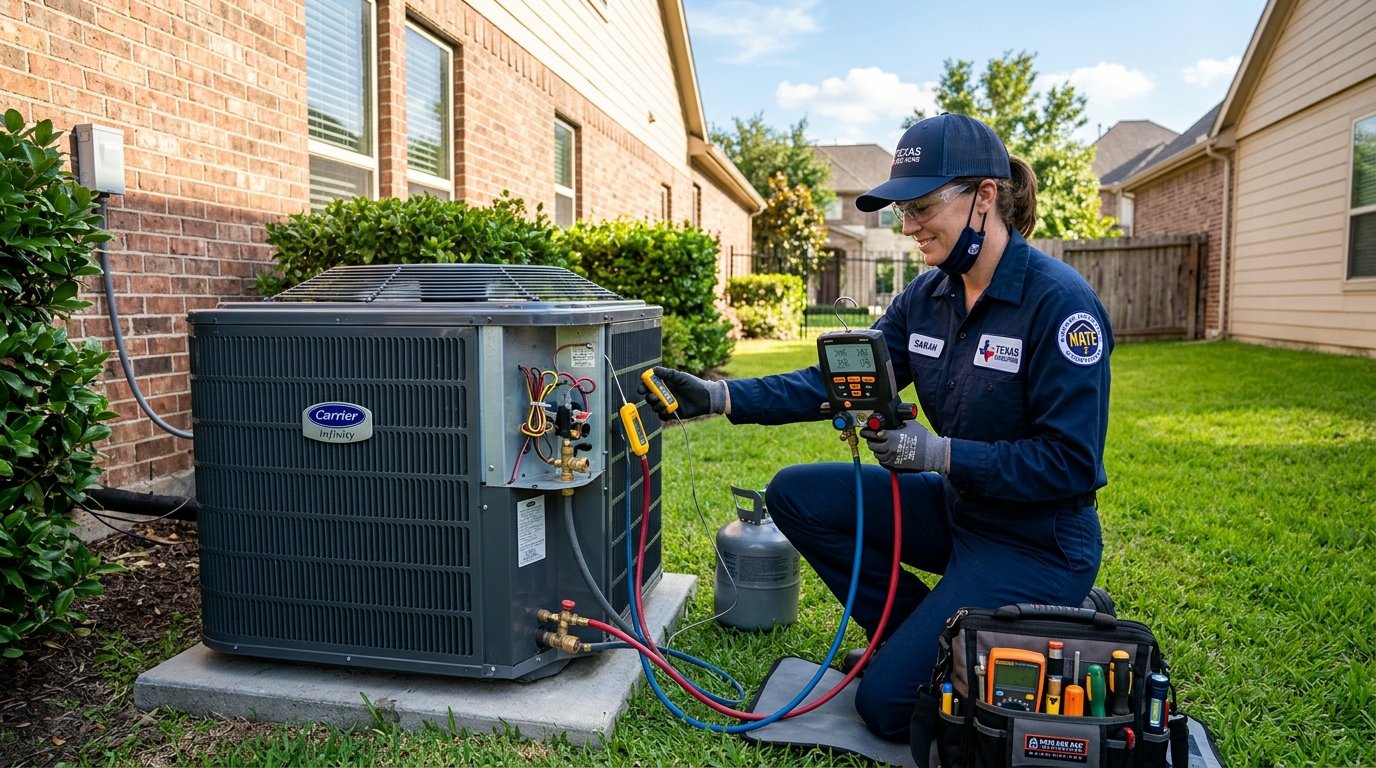
During the height of a North Texas summer, outdoor temperatures across Plano, Frisco, and Collin County frequently climb past 100°F. When you rely on your central cooling system to keep your home comfortable and safe, there is nothing more frustrating—or alarming—than walking up to a supply register only to feel lukewarm or heated air blowing out.
When an air conditioning system blows warm air, it means the indoor blower fan is still circulating air throughout your home, but the mechanical cooling cycle has broken down. Finding out exactly why this happens is the key to preventing permanent compressor burnout or costly secondary damage. At HVAC Plano repair specialists, our certified technicians troubleshoot cooling failures daily across local neighborhoods. Below, we break down the 5 most frequent reasons your AC is blowing warm air and how each problem should be resolved.
Quick Homeowner Checklist Before Calling a Technician:
1. Check your thermostat: Ensure it is set to "COOL" rather than "HEAT" or "FAN ONLY", and that the temperature setting is at least 3 degrees below the current room temperature.
2. Check the circuit breaker: Your air conditioner uses two separate breakers—one for the indoor furnace/air handler and one for the outdoor condenser. If the outdoor breaker tripped, the indoor fan will blow uncooled room-temperature air.
Thermostat Settings or Faulty Sensor
Fan switch toggled to "ON" instead of "AUTO", dead thermostat batteries, or sensor calibration drift.
Dirty Air Filter & Frozen Coils
Restricted airflow drops evaporator temperature below 32°F, encasing the coil in thick ice.
Low Refrigerant (Freon Leaks)
Hermetically sealed circuit losing pressure via cracks in copper lines or aluminum coils.
Failed Compressor or Blown Capacitor
The outdoor heart of your system cannot engage, leaving only indoor ambient air circulating.
1. Incorrect Thermostat Settings or Thermostat Malfunction
Before assuming a major mechanical failure, the simplest and most common reason for warm air blowing through your vents is an improper thermostat setting. Many homeowners unknowingly have their thermostat fan setting toggled to "ON" instead of "AUTO".
- In "AUTO" Mode: The blower fan only operates while the outdoor compressor is actively cooling refrigerant. Once the set temperature is reached, both the compressor and the fan shut off.
- In "ON" Mode: The indoor blower fan runs non-stop 24 hours a day, even when the outdoor condenser has completed its cooling cycle. As a result, the fan continues to blow warm, unconditioned air between cycles.
If your settings are correct but your system still blows warm air, your thermostat's internal temperature sensor or 24-volt control wiring may be failing. Older mercury or early digital thermostats frequently lose calibration over time. Upgrading to a modern, calibrated unit with professional thermostat repair and replacement ensures accurate temperature readings and seamless communication with your outdoor condensing unit.
2. Dirty Air Filters and Frozen Evaporator Coils
In Plano's dusty suburban environment and high pollen seasons, standard 1-inch pleated air filters can become completely choked with debris in as little as 30 to 45 days. When airflow into the return vents is restricted, heat transfer cannot take place properly.
Because the refrigerant circulating inside the indoor evaporator coil cannot absorb sufficient heat from your indoor air, the coil temperature drops below 32°F. Moisture condensing on the coil rapidly freezes into a thick block of ice. Once the evaporator coil is encased in ice, air cannot pass through the cooling fins, leading to weak, warm air blowing through your vents.
If you suspect frozen coils, turn the thermostat to "OFF" immediately and switch the fan to "ON" to thaw the ice. Never chip at the ice with sharp tools, as copper tubing and aluminum fins puncture easily. To restore unobstructed airflow and eliminate mold or grime buildup, schedule professional AC coil cleaning in Plano to thoroughly wash and sanitize both indoor and outdoor coils.
3. Refrigerant Leaks (Low Freon Levels)
Your air conditioning system does not "consume" or burn through refrigerant like an automobile burns gasoline. An HVAC system is a hermetically sealed, closed-loop circuit. If your system is low on refrigerant (such as R-410A), it means there is an active physical leak in the copper refrigerant lines, service valves, or coil joints.
Without adequate refrigerant pressure, the cooling cycle cannot extract heat from your indoor living spaces. Typical signs of a refrigerant leak include:
- Warm or lukewarm air flowing from air supply registers.
- A faint hissing or bubbling noise near the outdoor condenser or indoor air handler.
- Frost or ice forming along the insulated suction line outside.
- Unusually high electricity bills as the unit runs continuously trying to reach your thermostat setpoint.
Simply "topping off" refrigerant without repairing the source of the leak violates EPA Clean Air Act regulations and wastes money, as the gas will continue leaking out into the atmosphere. You need a licensed technician equipped with ultrasonic sniffers and nitrogen pressure gear for comprehensive refrigerant leak detection & repair to locate the crack, braze the copper, and recharge to exact factory specifications.
4. Failed AC Compressor or Blown Run Capacitor
The compressor is the mechanical heart of your air conditioning system. Located inside the outdoor condenser unit, the compressor pressurizes and pumps refrigerant between the indoor and outdoor coils. When the compressor fails to start, the refrigerant cannot circulate, leaving only ambient air flowing through your home.
In many instances, the compressor itself may still be functional, but the run capacitor powering it has failed. Capacitors store high voltage to give the compressor motor the electrical surge it needs to run. In Plano, where outdoor temperatures hover near triple digits and condenser cabinets easily reach 130°F inside, capacitors frequently bulge, leak dielectric fluid, or blow out.
If you hear your outdoor unit humming or clicking every few minutes without the condenser fan or compressor engaging, a faulty capacitor or burned electrical contactor is likely to blame. In more severe cases where the compressor has suffered mechanical seizure, expert AC compressor repair and replacement is required to evaluate whether a component swap or a new condensing unit is the most cost-effective path forward.
5. Blower Motor Problems & Disconnected Attic Ductwork
Even when your outdoor compressor and refrigerant system operate normally, indoor air distribution failures can result in warm air blowing into your rooms.
In North Texas, a majority of residential HVAC air handlers and ductwork networks are located inside unconditioned attic spaces. During midsummer, Plano attic temperatures routinely exceed 140°F. If an aged flex duct tears, collapses, or detaches from the supply plenum, your HVAC system will draw superheated attic air directly into the ductwork, blowing hot, dusty air straight into your bedrooms and living room.
Additionally, if your indoor blower motor suffers from electrical overheating, failing bearings, or a clogged squirrel cage wheel, it cannot produce the static pressure needed to push cooled air through the registers. In this scenario, professional blower motor repair and cleaning restores balanced airflow and stops the motor from overheating.
How to Prevent Warm Air AC Emergencies in Plano, TX
The best way to ensure your air conditioner delivers continuous, ice-cold air throughout blistering Texas summers is through proactive preventive care. Routine maintenance identifies worn capacitors, micro-refrigerant leaks, and dirty coils before they leave your household stranded in an unbearable heatwave.
Scheduling a comprehensive 28-point HVAC seasonal tune-up every spring includes tightening electrical connections, checking static pressure, lubricating motor bearings, clearing condensate drain lines, and verifying optimal refrigerant charge.
When to Call for Immediate Professional Assistance
While checking your thermostat and swapping a dirty air filter are great initial steps, you should shut down your cooling system and contact a professional immediately if:
- You smell electrical burning or melting plastic near the indoor furnace or outdoor unit.
- Your outdoor condenser unit trips your electrical breaker repeatedly.
- You see visible ice buildup across your indoor coil cabinet or exterior refrigerant lines.
- Your home temperature is steadily climbing during extreme Texas heat warnings.
Running an AC that is blowing warm air can cause catastrophic compressor burnout, turning a simple electrical fix into thousands of dollars in replacement equipment. For fast, reliable service anywhere in Collin County, turn to our 24/7 team for rapid emergency AC repair in Plano, TX.
Is Your Air Conditioner Blowing Warm Air in Plano?
Don't let North Texas heat take over your home. Our local Plano HVAC specialists are on standby 24/7 with fully equipped service vehicles to diagnose and repair your cooling system quickly.
Call Now: (214) 865-6331